Sports arm sleeves sit at an interesting crossroads between real sports science and marketing noise. A lot of what gets said about them overstates the evidence. Some of it understates it. The actual picture is more nuanced than either extreme.
Some of what these do has solid research behind it. Some of it does not. This guide separates the two, covers who actually benefits, which activities make the most sense, and what to look for when buying.
What the Research Actually Says
Sports compression research has been accumulating for decades. The evidence is clearest on a handful of specific outcomes and notably absent on others.
|
Claim |
Evidence |
Verdict |
|
Compression improves blood circulation |
Multiple peer-reviewed studies confirm graduated compression aids venous return |
Supported |
|
Reduces muscle vibration during activity |
Vibration damping via compression is well documented in running and cycling research |
Supported |
|
Speeds up recovery after training |
Studies on DOMS show compression reduces soreness in 24 to 48 hrs post-workout |
Supported |
|
Blocks UV radiation |
Nylon-polyester fabrics with UPF 50+ block 98% of UVA and UVB rays |
Supported |
|
Improves proprioception and joint sense |
Compression enhances sensory feedback from skin receptors to the brain |
Supported |
|
Directly increases peak power output |
Evidence is mixed; most studies show effect is small to negligible in healthy athletes |
Unclear |
|
Reduces injury risk on its own |
No strong evidence that sleeves alone prevent soft tissue injuries |
Not supported |
They work for specific things: circulation support, fatigue reduction, UV protection, and recovery. The evidence on direct power output gains is thin. That is a more useful frame than either blanket endorsement or dismissal.
The Three Benefits That Hold Up
Compression and Muscle Fatigue
Compression in this type of sleeve works through graduated pressure that is tighter at the wrist and progressively looser toward the elbow or upper arm. This pressure gradient supports venous return, which is the process of blood flowing back toward the heart from working muscles. Better venous return means metabolic waste products clear from the muscles faster during sustained activity.
It does not make you stronger. It makes you less tired over time. For an endurance athlete or a cricketer deep into a fielding session, that difference is real.
Muscle Vibration Damping
When you run or cycle, your muscles experience micro-vibration every time your foot strikes the ground or you hit a bump. This is called muscle oscillation, and it contributes to fatigue accumulation over long distances. Compression sleeves reduce this oscillation. The effect is modest, but across a two-hour run or a 100 km ride it adds up.
Cricketers and racket sport athletes benefit differently. Compression on the forearm helps stabilise the muscles around the elbow, which reduces the repetitive strain load on the joint during sustained bowling or serving.
DOMS Reduction and Recovery
Delayed onset muscle soreness, the stiffness that peaks 24 to 48 hours after a hard session, is measurably reduced with compression wear. Multiple studies on runners and weightlifters show that wearing compression sleeves during and after training leads to less soreness and faster return to full training intensity. Less soreness means you can train again sooner. Over weeks and months, that compounds.
Who Benefits Most from Sports Arm Sleeves
Not every activity gets the same return from them. Here is where the benefits land most clearly:
|
Activity or User |
Primary Benefit |
Secondary Benefit |
|
Long-distance cyclist |
Reduces arm fatigue and muscle vibration |
UV protection on multi-hour rides |
|
Motorcycle rider |
UV and dust barrier, keeps arms cool |
Compression reduces fatigue on long stretches |
|
Cricketer |
UV protection during fielding |
Arm muscle warmth during bowling |
|
Runner |
Compression reduces DOMS the next day |
UV coverage in outdoor training |
|
Gym athlete |
Compression support during heavy lifts |
Keeps arm muscles warm pre-workout |
|
Trekker or hiker |
UV protection on exposed trails |
Muscle support on long descents |
|
Tennis or badminton |
Elbow joint proprioception support |
Sweat management on the playing arm |
The common thread is sustained activity: long duration under sun exposure, or repeated muscular effort over hours. For a 20-minute gym session, they do not add much. For anything lasting an hour or more under physical load, the case for wearing them gets real.
What to Look for When Buying Sports Arm Sleeves
Once you have decided a sleeve makes sense for your activity, these are the features that actually separate a useful option from one that just looks the part:
• Compression level: Light to moderate compression works for most sports use. Heavy compression is for medical use and tends to feel restrictive during movement. Snug but not tight is the right benchmark.
• Fabric construction: Nylon-spandex or polyester-spandex blends give the right combination of stretch, compression, and moisture management. Cotton does not work for active use.
• UPF rating: If outdoor use is the main scenario, UPF 50+ is the standard to look for. This rating means the fabric blocks 98% of UV radiation, significantly better than untreated fabric.
• Seamless design: Seams at the elbow or forearm create pressure points during extended activity. Seamless construction is more comfortable on long rides, runs, and fielding sessions.
• 4-way stretch: Fabric that stretches in all four directions moves with your arm naturally. It does not bunch, restrict rotation, or feel constrictive at any joint angle.
A Sports Arm Sleeve Built Around These Specifics
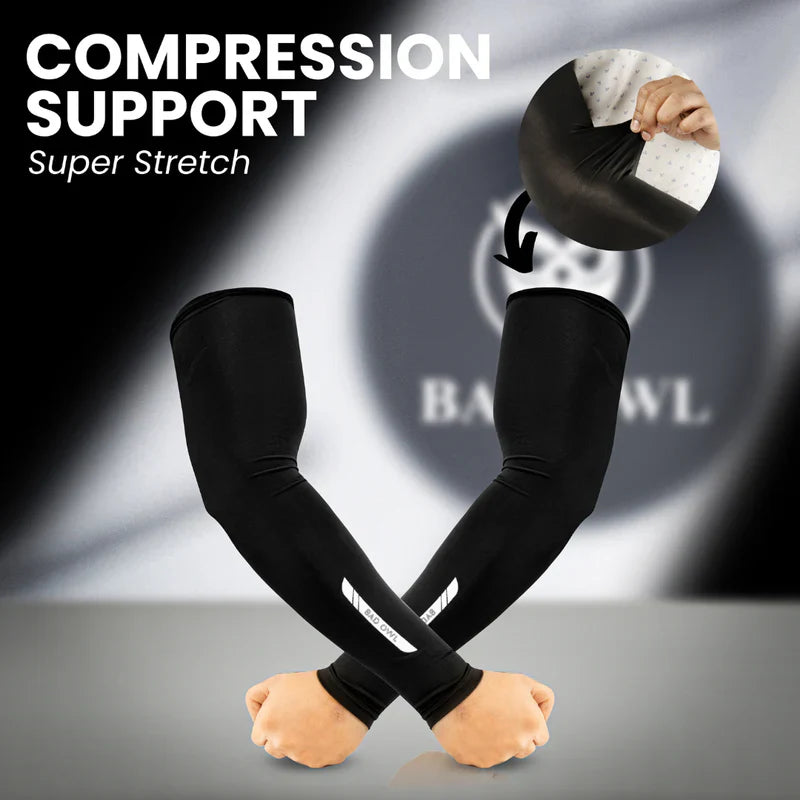
The BADOWL Velocity Arm Sleeves from Bad Owl are built around the five criteria above. UPF 50+ construction that blocks 98% of UVA and UVB. Seamless compression that does not create pressure points at the elbow. 4-way stretch fabric that adapts to full arm movement without restriction. Moisture-wicking material that stays dry through intense runs, cycling sessions, and long training days.
Designed for all-weather and all-activity use, it covers the most common Indian outdoor sports scenarios: cricket, cycling, running, and riding. Available in multiple options.
Available at badowl.in
Wearing Sleeves vs Nothing: The Practical Case
If you train outdoors regularly in India, the case for wearing them is less about performance gains and more about removing small problems that accumulate across a week of training.
• You stop worrying about sunscreen washing off mid-run or mid-ride
• Your forearms feel less fatigued after long sessions, which is real even if it is hard to quantify exactly
• You recover faster between back-to-back training days
• You keep dust and pollution off your skin on rides through traffic
• The sleeve does not shift, bunch, or require readjustment during activity
None of these are dramatic. They are small improvements that accumulate over weeks of consistent training. That is what they actually do, and it is more useful than any performance claim.
About Bad Owl
Bad Owl (badowl.in) builds riding and sports gear for the Indian market. The range covers arm sleeves, riding gloves, knee support, balaclavas, wrist support, and more. Everything is designed around Indian road and weather conditions rather than adapted from foreign market products. The catalogue is competitively priced and ships across India.
The Velocity Arm Sleeves are a natural starting point if sleeves are what brought you here. The rest of the range is worth exploring, particularly the riding gear, which is built specifically for Indian road conditions.
Full store: badowl.in
Frequently asked questions
Do sports arm sleeves actually improve performance?
Sports arm sleeves offer proven benefits for specific outcomes but do not directly increase peak power output. Research consistently supports their role in reducing muscle fatigue, damping muscle vibration during sustained activity, speeding up recovery from soreness, and blocking UV radiation. The evidence on direct performance gains is mixed and largely negligible in healthy athletes. Their real value is in helping you train more consistently by reducing fatigue and recovery time across back-to-back sessions.
What activities benefit most from wearing arm sleeves?
Arm sleeves provide the clearest benefits during sustained, long-duration activities. Cyclists, long-distance runners, cricketers, trekkers, motorcycle riders, and racket sport athletes all see meaningful returns — primarily from UV protection, reduced arm fatigue, and muscle vibration damping. For shorter sessions under an hour, the benefit is minimal. The longer and more physically demanding the activity, especially outdoors, the stronger the case for wearing them.
What UPF rating should I look for in sports arm sleeves?
UPF 50+ is the standard to look for if outdoor use is your main scenario. A UPF 50+ rated fabric blocks 98% of both UVA and UVB radiation, which is significantly more protection than bare skin or untreated fabric. This is particularly relevant for Indian outdoor sports like cricket, cycling, and running, where prolonged sun exposure is common. Sleeves with UPF 50+ also remove the need to reapply sunscreen to your arms during long sessions.
How do compression arm sleeves help with muscle recovery?
Compression sleeves support recovery by improving venous return — the process of blood flowing back from working muscles toward the heart. This helps clear metabolic waste products like lactic acid from the muscles more efficiently after training. Multiple studies on runners and weightlifters show that wearing compression sleeves during and after exercise measurably reduces delayed onset muscle soreness (DOMS) in the 24 to 48 hours post-workout, allowing athletes to return to full training intensity sooner.
What fabric and construction features should I look for when buying arm sleeves?
Look for nylon-spandex or polyester-spandex blends, which provide the right combination of compression, stretch, and moisture management. Avoid cotton — it retains sweat and loses shape during activity. Seamless construction prevents pressure points at the elbow during extended use. Four-way stretch fabric ensures the sleeve moves naturally with your arm without bunching or restricting rotation. For compression level, light to moderate is appropriate for sports use; heavy compression is designed for medical applications and can feel restrictive during movement.