|
# |
What to Check |
Why It Matters |
|
1 |
Knuckle protection |
Your first point of contact in any fall |
|
2 |
Palm grip and padding |
Controls fatigue and handlebar feel |
|
3 |
Ventilation and fabric |
Critical for Indian heat and humidity |
|
4 |
Wrist closure |
Keeps the glove in place at speed |
|
5 |
Full-finger coverage |
Protects fingers in slides and debris |
|
6 |
Touchscreen compatibility |
Avoids removing gloves in traffic |
|
7 |
Fit for your city's conditions |
Heat, dust, rain need different priorities |
1. Knuckle Protection That Is Actually Hard
This one gets glossed over in a lot of glove marketing. Knuckle protection means a hard shell or reinforced insert sitting over the knuckles. It does not mean a padded fabric bump. In a fall, your knuckles are the first thing that contacts the ground, tarmac, or another vehicle. Foam compresses and transfers impact. A hard insert does not.
Check the product description carefully. If it says padding or cushioning around the knuckles rather than hard shell or reinforced guard, that is not knuckle protection in any meaningful sense.
2. Palm Padding That Targets the Right Zones
Palm padding is not just about comfort. It directly affects how fatigued your hands get on long rides. Road vibration travels up through the handlebar constantly, and without proper palm padding it accumulates in the muscles and tendons of your palm and wrist over time.
Gel inserts positioned over the ulnar nerve area on the outer palm are what you want. Foam padding is acceptable for short rides but compresses faster and loses effectiveness. If the glove only has thin fabric on the palm, skip it for anything beyond short city use.
The Ventilation Question: Getting Riding Gloves Right for Indian Heat
Indian summers run from March through September in most parts of the country. A glove with minimal ventilation becomes unwearable within weeks. Your palms sweat, grip degrades, and the inside of the glove starts to retain moisture in a way that is both uncomfortable and bad for the material.
Mesh panels on the back of the hand are the standard solution. They allow airflow while the palm side maintains grip and protection. Perforated leather is a middle ground that works in moderate heat but still runs warmer than full mesh. For daily summer commuting in Indian cities, full mesh back panels are the practical choice.
The fabric composition matters too. Nylon-spandex blends with moisture-wicking inner linings move sweat away from the skin rather than trapping it. Cotton inner linings hold moisture and get uncomfortable fast.
4. Wrist Closure That Actually Holds
A wrist strap that does not hold is a glove that shifts mid-ride. When that happens, the padding moves off the palm, the knuckle guard sits slightly off position, and your grip has a layer of bunched fabric under it. The whole protection function of the glove is compromised.
Velcro closures work well when the velcro is wide enough and makes solid contact. Elastic-only closures are fine for light use but stretch out over time. For highway riding, look for a wrist closure that can be tightened to a snug fit without restricting blood flow.
5. Full-Finger Coverage for Indian Roads
Half-finger gloves feel like the obvious choice in heat. They are cooler, no question. But your fingers are exposed in a fall, and Indian roads come with their own category of hazards: unpredictable potholes, debris, gravel patches, and the general chaos of mixed traffic where a slide is not always a slow, clean one.
Full-finger mesh gloves have improved significantly. A thin mesh full-finger glove in Indian summer conditions is not dramatically hotter than a half-finger option, and the finger protection it provides is worth it for anyone riding more than 20 minutes at a stretch. For city riding where unexpected stops and incidents are more likely than on controlled highway stretches, full-finger coverage is the more sensible default.
6. Touchscreen-Compatible Fingertips
This sounds like a luxury feature. In Indian city riding it is not. You need to check maps at junctions, attend calls at lights, enter OTPs, and interact with your phone regularly on a daily commute. Removing gloves every time you need to do this is both impractical and creates a habit of riding with one glove or none at all.
Touchscreen-compatible fingertips are now standard on most decent gloves. Check that the fingertip actually works before you buy, since the quality varies. Some respond well, others require firm pressure that defeats the purpose.
7. Match the Glove to Your City's Conditions
This is the item most buying guides skip. The right glove for one Indian city is not necessarily right for another. Conditions vary enough that it is worth thinking about your specific riding environment before you decide.
Riding Gloves in Delhi: Delhi riding means extreme dry heat in summer, heavy dust and particulate matter from traffic, and a long season where ventilation is the dominant concern. Full mesh construction with UV-blocking outer fabric is the combination that works here. The dust factor also means you will be washing your gloves regularly, so fabric that holds its shape and compression through repeated washes is worth checking for.
Riding Gloves in Bangalore: Bangalore's combination of humidity and a longer monsoon window changes the priorities slightly. Moisture-wicking becomes more important than in dry heat because sweat lingers rather than evaporating. Quick-dry fabric is a practical requirement for daily riders who do not always have time to let gear dry overnight. Bangalore also has a cooler season where a slightly heavier glove becomes comfortable for a few months, so a versatile mid-weight mesh option covers more of the year.
Wherever you ride, the underlying principle is the same: your riding gloves should be chosen for what your roads, your climate, and your daily riding pattern actually demand, not for what looks good in a product photo.
Where Bad Owl Fits In
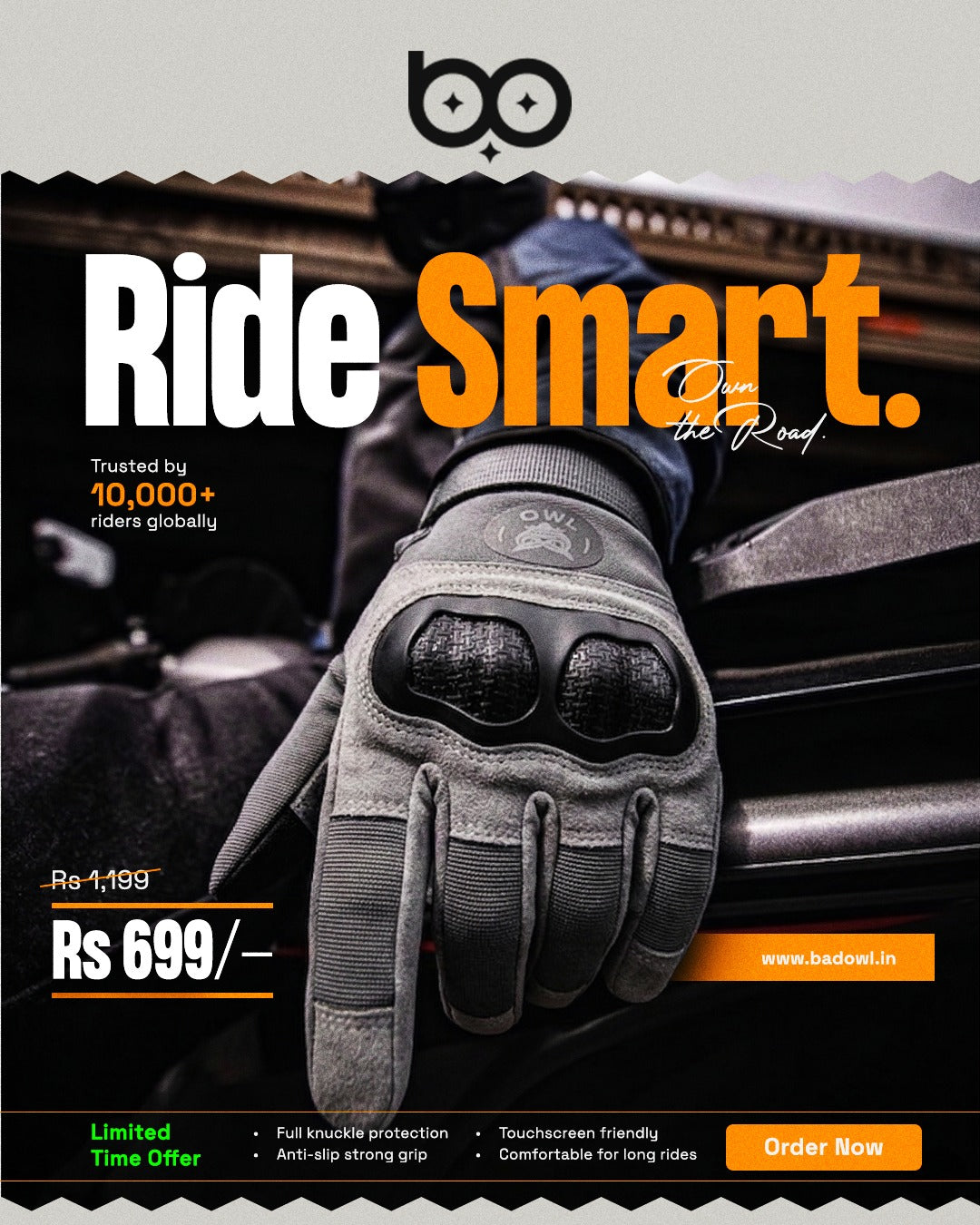
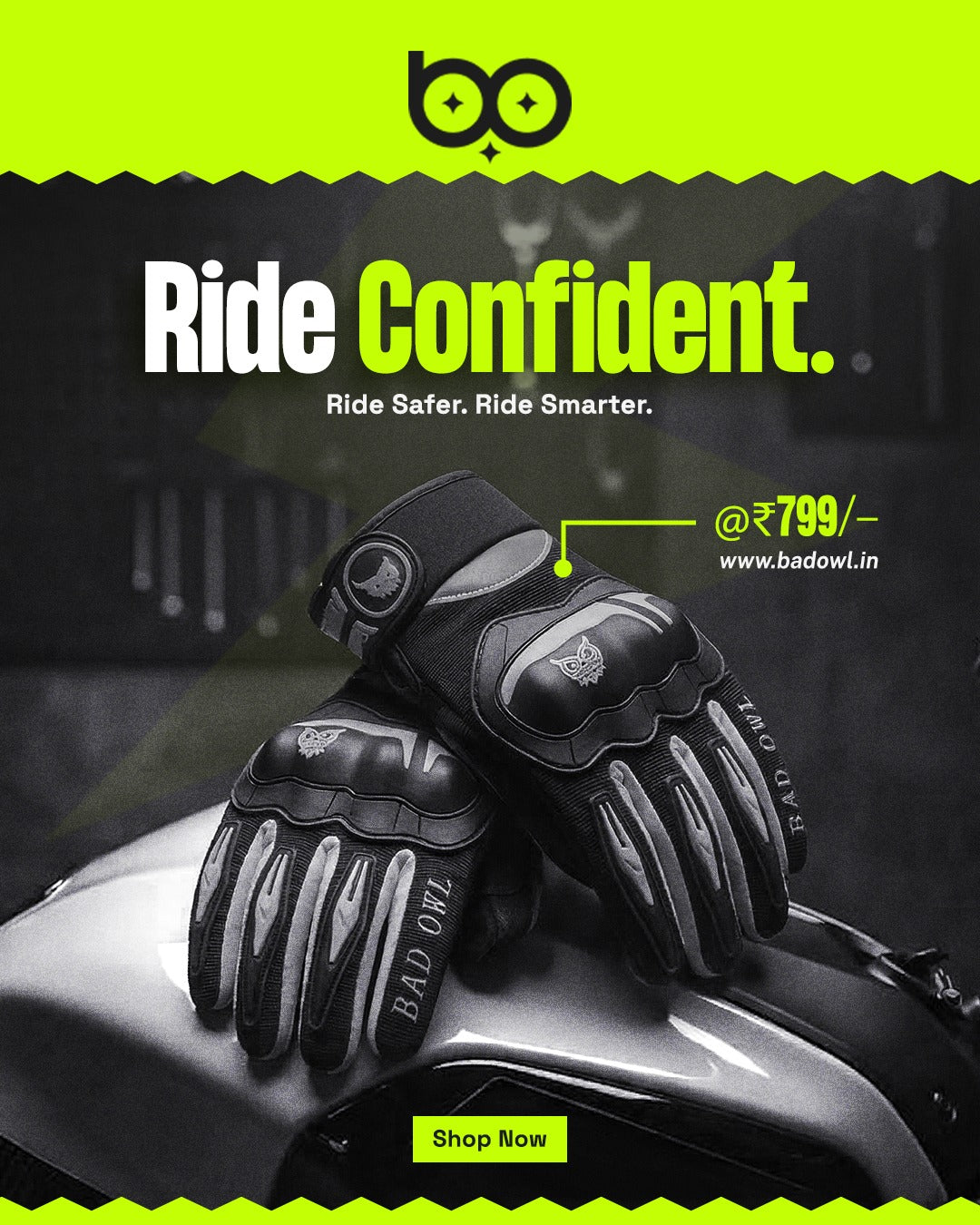
Bad Owl (badowl.in) builds riding gear specifically for Indian conditions. The gloves range covers full-finger options with mesh ventilation, knuckle protection, palm padding, and touchscreen-compatible fingertips. Everything is designed for the kind of riding most Indian riders actually do: city commutes, mixed traffic, and occasional highway stretches. The range is competitively priced and available in different options to suit different hand sizes and riding styles.
Browse the full range at badowl.in
FAQs
Do I really need to buy riding gloves with hard knuckle protection or is padding enough?
Hard protection is the better choice if you are buying a pair for regular use. Padding compresses on impact and transfers force to your hand. A hard shell or reinforced insert distributes and absorbs that force instead. The difference is most obvious in higher-speed impacts, but even a slow urban fall can result in significant knuckle injury without a hard insert. Padding is acceptable for casual short rides; hard protection is the right call for daily commuting.
How do I know if the riding gloves I am considering will work in Indian summer heat?
Check for three things: mesh or perforated panels on the back of the hand, a moisture-wicking inner lining, and silicone grip zones on the palm. If all three are present, the glove is built for active ventilation and sweat management. If the glove is full leather with minimal ventilation, it will be uncomfortable within minutes in peak Indian summer regardless of how good the protection features are.
Is the wrist closure really that important?
More than most people expect. A wrist closure that does not hold means the glove shifts during a ride, and a shifted glove is a glove with the palm padding no longer over the palm and the knuckle guard sitting off-centre. Beyond protection, a loose wrist closure creates a gap that allows wind and dust in at speed, which is uncomfortable on longer stretches. A solid velcro or adjustable strap closure is worth checking specifically before you buy.
What is the difference between a glove built for Indian conditions and a generic riding glove?
Indian conditions put specific demands on gear that general-purpose gloves often do not account for: prolonged heat, high UV index, mixed traffic that requires frequent phone use, and monsoon moisture that requires quick-dry construction. A glove designed for European touring or cold-weather riding will typically prioritise insulation and waterproofing over ventilation and moisture management, which is the wrong balance for six months of the Indian riding calendar.
Seven things sounds like a lot to check. In practice it takes about two minutes once you know what you are looking for. The difference between a glove that works and one that gets abandoned in a drawer after three rides comes down to whether it was chosen for your actual riding conditions or just picked off a shelf.